

Communicating Pharmacy Changes: Why Good Strategy Fails Without Good Messaging
Five pharmacy change scenarios with complete messaging frameworks: member letters, FAQs, provider outreach, and language to avoid

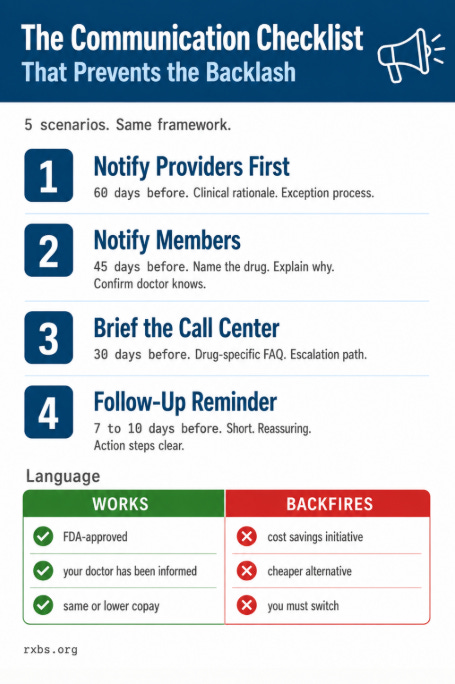
To communicate a pharmacy benefit change well, notify prescribers first (60 days out), then members with a specific letter that names the drug and confirms their doctor knows (45-60 days out), then brief the call center (30 days out), and use plain reassuring language (”FDA-approved,” “your doctor has been informed,” “same or lower copay”) rather than cost-savings framing; the variable that decides whether a change lands smoothly is timing, specificity, and coordination, not the clinical decision.
At Prescription Benefit Solutions, we helped two employers implement the same biosimilar transition program within months of each other. Same clinical rationale, same PBM. One generated a wave of member complaints and prescriber pushback. The other had zero complaints. The difference was not the pharmacy strategy. It was the communication strategy.
The first employer treated communication as an afterthought. Members received a generic formulary change letter 14 days before the switch. Prescribers were not notified. The call center was not briefed on the specific change. Members called their doctor. The doctor did not know. Both called the benefits team. The complaints escalated.
The second employer treated communication as part of the implementation. Members received a specific letter 45 days before the switch, explaining what was changing, why, and that their doctor had been informed. Prescribers received a clinical communication explaining the evidence supporting the transition. The call center was briefed with a specific FAQ. Zero complaints.
Same program. Same clinical decision. Same financial outcome. Completely different member experience. The variable was timing, specificity, and coordination.
What follows is the template library we use with clients: the five change scenarios that generate the most friction, each with the advance-notification language, the provider communication, the sequence that has to run behind it, and the specific phrases that reliably backfire. At the end there is a printable audit you can run against a change before a single letter mails.
Why pharmacy changes feel personal
Pharmacy benefit changes are uniquely sensitive because members associate drug changes with quality-of-care changes. When an employer switches to a biosimilar, the member hears “they are taking away my medication.” When a formulary tier changes, the member hears “they are making my drug more expensive.” When a prior authorization is added, the member hears “they are creating a barrier to my treatment.”
None of those interpretations may be accurate. But they are how members experience the change. And if the communication does not proactively address the emotional response, the clinical and financial rationale does not matter. The member complaint has already been filed.
The communication template library
Five scenarios. For each: the advance notification letter, the language to use, the language that backfires, and the provider communication where the change touches prescribing. The call center script and the FAQ that sit behind all five follow the scenarios. These are the templates we use with clients.
Scenario 1: Formulary Tier Change
A drug moves from a lower tier to a higher tier, increasing member cost-sharing.
Advance notification (45 days before):
“Your prescription for [drug name] will move to a different cost-sharing tier effective [date]. Your new copay will be [amount]. This change affects approximately [number] of medications on our formulary as part of an annual review to ensure our drug coverage reflects current clinical evidence and cost management.”
Language to use: “Annual formulary review.” “Reflects current clinical evidence.” “Lower-cost alternatives may be available.”
Language to avoid: “Cost savings initiative.” “Budget reduction.” “Your medication is being removed.” (It is not being removed; the cost-sharing is changing.)
Provider communication: Notify prescribers 60 days before with affected drug list and therapeutic alternatives. “We want to ensure you are aware so you can discuss options with your patients.”
Scenario 2: Biosimilar Transition
Members currently on a brand biologic are transitioned to a biosimilar.
Advance notification (60 days before):
“Your biologic medication [brand name] is being transitioned to [biosimilar name], an FDA-approved biosimilar that is clinically equivalent. Your doctor has been informed. Your copay will remain the same or may decrease. This transition is supported by clinical evidence showing no meaningful difference in safety or efficacy.”
Language to use: “FDA-approved.” “Clinically equivalent.” “Your doctor has been informed.” “Copay may decrease.”
Language to avoid: “Generic version.” (Biosimilars are not generics.) “Cost containment measure.” (Frames as takeaway.) “Cheaper alternative.” (Implies lower quality.)
Provider communication: Send clinical summary with FDA biosimilar evidence, specific to the drug class. Include the transition timeline and how to request a clinical exception if medically necessary.
Scenario 3: Specialty Pharmacy Routing Change
Members are directed to a new specialty pharmacy for their medications.
Advance notification (45 days before):
“Your specialty medication will now be dispensed through [pharmacy name]. Your medication, dose, and coverage remain the same. Only the pharmacy that fills and ships your medication is changing. [Pharmacy] will contact you before your next refill to coordinate the transition.”
Language to use: “Same medication. Same coverage.” “The pharmacy will contact you.” “No action required on your part.”
Language to avoid: “Mandatory pharmacy change.” “You must transfer.” “Failure to comply will result in...”
Scenario 4: Prior Authorization Implementation
A new PA requirement is added to a drug or drug category.
Advance notification (30 days before):
“Starting [date], [drug name/category] will require prior authorization. If you currently take a medication in this category, your doctor’s office will work with your pharmacy benefit to confirm the authorization. In most cases, this process is completed without any disruption to your prescription.”
Language to use: “Your doctor’s office will handle this.” “In most cases, no disruption.” “Ensures appropriate use.”
Language to avoid: “Your prescription may be denied.” “You may need to switch medications.” “New restriction.”
Scenario 5: Pharmacy Network Change
A pharmacy is removed from the network or the network is narrowed.
Advance notification (60 days before):
“Your pharmacy benefit network is being updated effective [date]. [Pharmacy name] will no longer be in-network. The following in-network pharmacies are within [distance] of your location: [list]. You may also use our mail order pharmacy for maintenance medications.”
Language to use: “Updated.” “Convenient alternatives nearby.” “Mail order available.”
Language to avoid: “Your pharmacy has been terminated.” “You can no longer use...” “Network reduction.”
The coordination that matters
For each scenario, the sequence is: provider communication first (60 days), member communication second (45-60 days), call center briefing third (30 days), and follow-up communication (7-10 days before effective date). This sequence ensures the provider knows before the member calls them, the member has time to ask questions, and the call center has specific answers.
Every step in that sequence needs a named owner before the first letter is drafted. In most failed rollouts we review, no single person owned prescriber notification, and each party assumed the PBM was handling it. Ask the question directly in the implementation meeting: who is notifying prescribers, on what date, using what list. The silence that sometimes follows is the finding.
The call center script and the FAQ behind it
The call center is where the plan either holds or collapses, because it is the only part of the sequence that has to work in real time. Two documents make that possible, and both have to exist before the first letter mails.
The FAQ is the internal document: every question the change can generate, with the approved answer, ordered the way members actually ask them. What is changing. Why. What it costs me. What do I do next. Who decides if I am an exception.
The script is the first thirty seconds of the call.
“Thank you for calling about your [drug name] letter. Your medication is still covered. What is changing is [the specific change]. Your doctor’s office received notice on [date]. If [drug] is not clinically appropriate for you, there is an exception process, and I can start it on this call.”
Language to use: “Still covered.” “Your doctor’s office was notified on [date].” “I can start that on this call.”
Language to avoid: “That is a formulary decision.” “You will need to call your PBM.” “I do not have that information.” (Each one converts a two-minute call into an escalation.)
The parts that make the script work are the parts a vendor template cannot supply: the drug named, the date the prescriber was notified, and an exception path the representative can actually open instead of transfer. If the call center cannot do all three, the letters are not ready to mail.
When you cannot give 60 days
Not every change comes with a clean runway. A mid-year formulary action, a network termination, or a specialty routing change forced by the vendor can land with three weeks of notice. Compress the sequence rather than skipping steps: providers and members in the same week rather than 15 days apart, the call center briefed before either goes out rather than after, and a named exception path in the member letter itself so the first call has somewhere to go. What cannot be compressed is the exception process. A short notice period with no clinical exception path is the combination that produces escalations to HR, because the member’s only remaining option is to complain to the plan.
The audit before the letters go out
Your broker can help coordinate the timing and review the messaging. The best advisory teams treat communication as a deliverable in the implementation plan, not an afterthought. Our printable Member Transition Audit turns the sequence above into a pre-launch check: who is notified, in what order, with what language, and what the exception path is. Run it before the letters are approved, not after the complaints arrive. For the contract language that obligates the PBM to support these transitions, see our PBM Contract Language Library.
Have you implemented a pharmacy change where the communication made or broke the outcome? Leave a comment below.
For the full protective contract language on formulary management, see our free PBM Contract Language Library: https://www.rxbs.org/contract-language-library. Updated quarterly from patterns we see in client contract reviews.
Questions? team@rxbs.org. Subscribe to Benefit Blind Spots.