

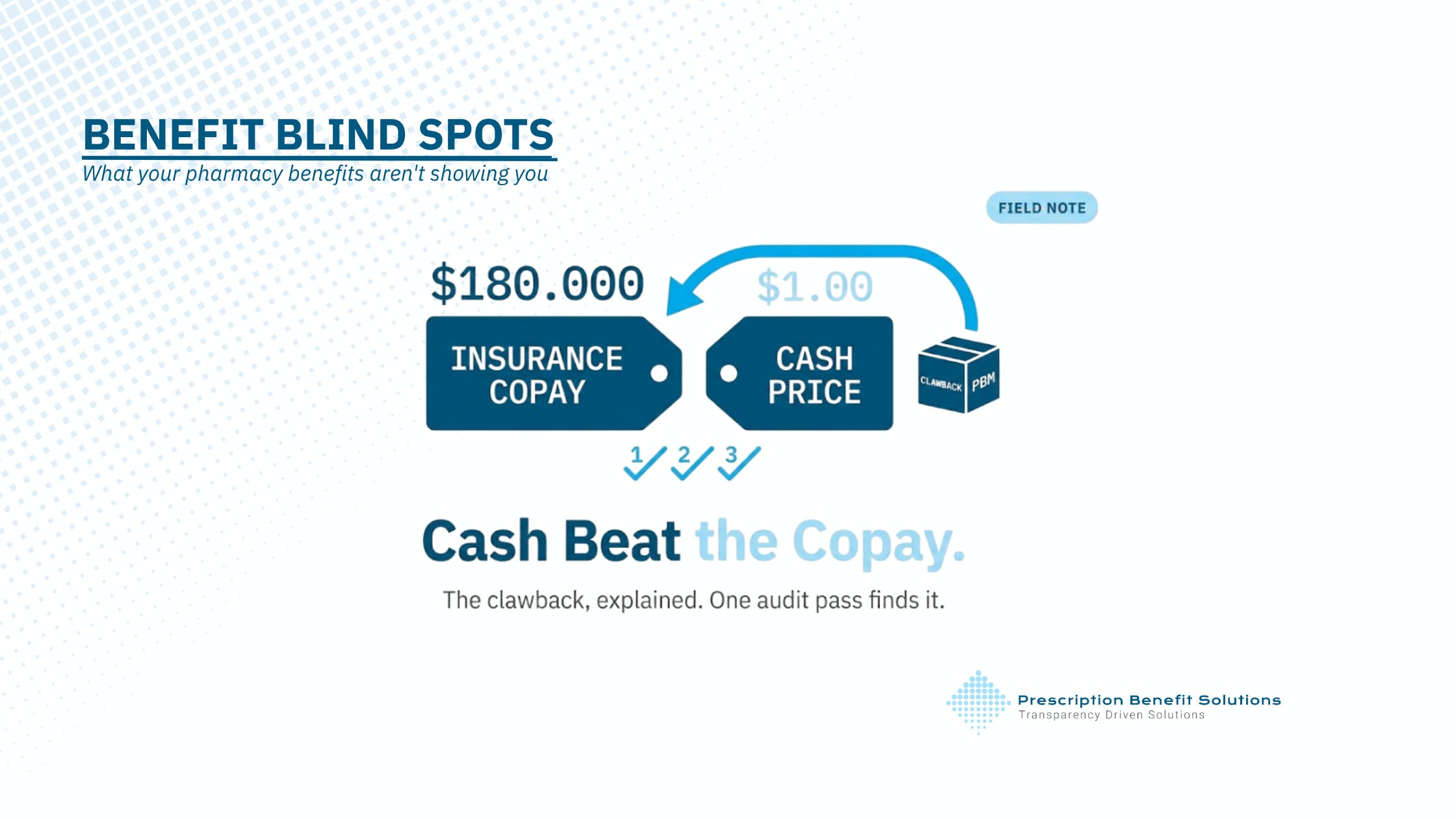
The cash price can beat your insured copay because of a practice called a clawback: when a member’s copay is set higher than what the PBM reimbursed the pharmacy for the drug, the pharmacy collects the higher copay at the counter and the PBM claws back the difference; on cheap generics the whole copay can exceed the drug’s actual cost, so the member pays more for using insurance, and a plan sponsor finds it by sorting claims for every line where member cost-share exceeded the plan’s own net cost on the drug.
This morning’s LinkedIn post landed the shock: for some of your employees’ generics, the cash price is lower than the copay your plan charges them. They pay more because they used their insurance. Here is the mechanism, why it happens, and how to catch it on your own plan.
At Prescription Benefit Solutions, we sort client claims by where the member’s copay exceeded the plan’s own net cost on the drug, as a standard part of our work. On generics, that list is rarely empty. The companion Copay Card Financial Impact Calculator models what your members actually pay against the cash and assistance alternatives.
What a clawback actually is
When you set a flat generic copay, say a single tier amount for all generics, you guarantee that on the cheapest drugs the copay will exceed what the PBM paid the pharmacy. The pharmacy is contractually required to collect the full copay, then remit the overage back to the PBM. That remittance is the clawback. The member experiences it as a normal copay. It is, on those claims, a markup that flows to the middleman.
A USC Schaeffer Center study found patients overpaid on roughly one in four prescription fills, paying more through insurance than the cash price would have been. The worst cases are cheap generics: a $3 drug under a flat $10 copay is a guaranteed overpayment.
Illustrative example for educational purposes. Actual amounts vary by plan.
Why your members do not know
For years a gag clause in PBM-pharmacy contracts barred the pharmacist from telling a patient the cash price was lower. The Patient Right to Know Drug Prices Act of 2018 banned those gag clauses federally, and 18 states now also ban the clawback itself. But the protection is passive: the pharmacist generally still has to wait for the member to ask, and your member does not know to ask. Discount tools (GoodRx, Mark Cuban Cost Plus Drugs) make the cash price visible, but only to the member who thinks to check.
The one audit pass that finds it
Pull your generic claims for a recent period. For each claim, compare the member’s total cost-share against the plan’s net cost on the drug (ingredient cost plus dispensing fee, net of any reimbursement). Flag every line where the member paid more than the plan’s net cost. That list is your clawback exposure: each line is a member who paid extra to use the benefit you are funding.
What to do
Audit: sort generic claims for every line where member cost-share exceeded plan net cost. Contract: bar clawbacks outright and require copays not exceed the plan’s net cost on the drug. Communicate: tell employees, in plain member-facing language, that on some generics the cash price is lower and they can ask the pharmacist or check a discount price.
The shock is that cash can beat the copay. The fix is a contract clause and one sentence in your member materials.
Questions? team@rxbs.org.