
Why Does Your PBM Mark Up the Sickest Member's Generic the Most?
What the FTC found about specialty generic markups, and how a plan sponsor audits where the markup lands on its own members

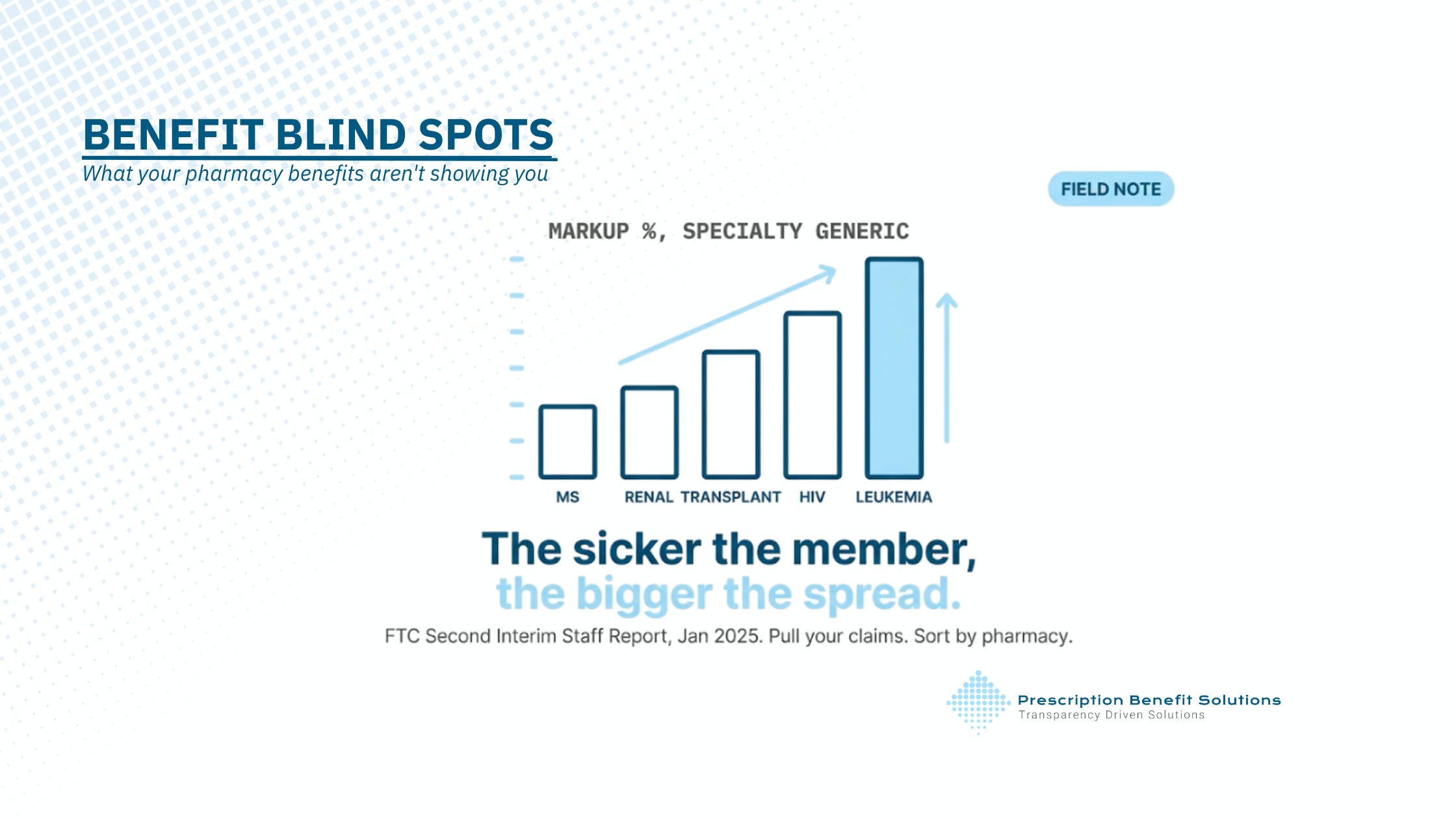
The big-3 PBMs mark up specialty generic drugs the most at the pharmacies they own, and the FTC found the largest markups landed on the generics for leukemia, multiple sclerosis, transplant, renal disease, and HIV, so the markup scales with how sick the member is; to audit your own plan, pull your specialty generic claims, sort by filling pharmacy, and compare what your PBM billed your plan against the public NADAC acquisition benchmark for the same drug.
The FTC’s Second Interim Staff Report on prescription drug middlemen, released January 2025, studied every specialty generic drug the big-3 PBMs dispensed from 2017 to 2022: 51 drugs across 882 National Drug Codes. The list is not lifestyle medications. It includes the generic versions of Gleevec (leukemia), Ampyra (multiple sclerosis), Myfortic (transplant rejection), and Sensipar (renal disease), plus HIV generics. The FTC found the big-3 reimbursed their own affiliated pharmacies at rates marked up more than 100% over estimated acquisition cost on roughly two-thirds of these drugs, and more than 1,000% on more than one in five. Those markups produced an estimated $7.3 billion above what the drugs cost, plus $1.4 billion more from spread pricing.
Read that again with the clinical lens on. The drugs carrying the biggest spread are the ones a cancer patient, a transplant recipient, or a person living with HIV depends on to stay alive. The markup scales with how sick your member is.
At Prescription Benefit Solutions, we audit hundreds of PBM contracts a year, and the specialty-generic markup is in most of them. Here is how to check your own plan.
Pass one: pull your specialty generic claims and sort by filling pharmacy
Request a claim-level extract of your specialty generic fills for the past 12 months. Sort by the dispensing pharmacy. In most plans we audit, well over half of specialty volume runs through a pharmacy the PBM owns. No member chose that. The prior-authorization and routing rules chose it for them.
Pass two: compare the billed price to the public acquisition benchmark
There is a public price for what a generic costs a pharmacy: NADAC, the National Average Drug Acquisition Cost. For each high-cost specialty generic, put two numbers on one line: what your PBM billed your plan, and the NADAC acquisition cost for the same NDC. The gap is the markup. The FTC found that gap, billed through PBM-owned pharmacies, grew at a 42% compound annual rate.
Pass three: tie it back to the clinical program your PBM reports
This is where Monday’s deep dive and today’s reveal meet. Your PBM’s specialty management program reports savings. Ask the program a direct question: does its savings methodology account for the markup it collected at its own pharmacy on these exact drugs? A clinical program that claims to manage specialty spend but never audits where the per-member markup lands is reporting a number, not delivering the ROI it claims.
What to do this quarter
Pull the specialty generic claims and sort by filling pharmacy. Compare billed price to NADAC on your highest-cost specialty generics. Send the markup back to the clinical program and ask whether its reported savings net it out.
The reveal is the hook. The audit is the deliverable. The paste-ready version of all three passes is our Specialty Routing Audit Worksheet, free. For how this fits inside a full pharmacy benefit review, see our Contract Review Readiness Checklist.
This is a Field Note. Questions? team@rxbs.org.